- This event has passed.
250th Anniversary of America: The Religious Conflicts of Europe’s Confessional Era
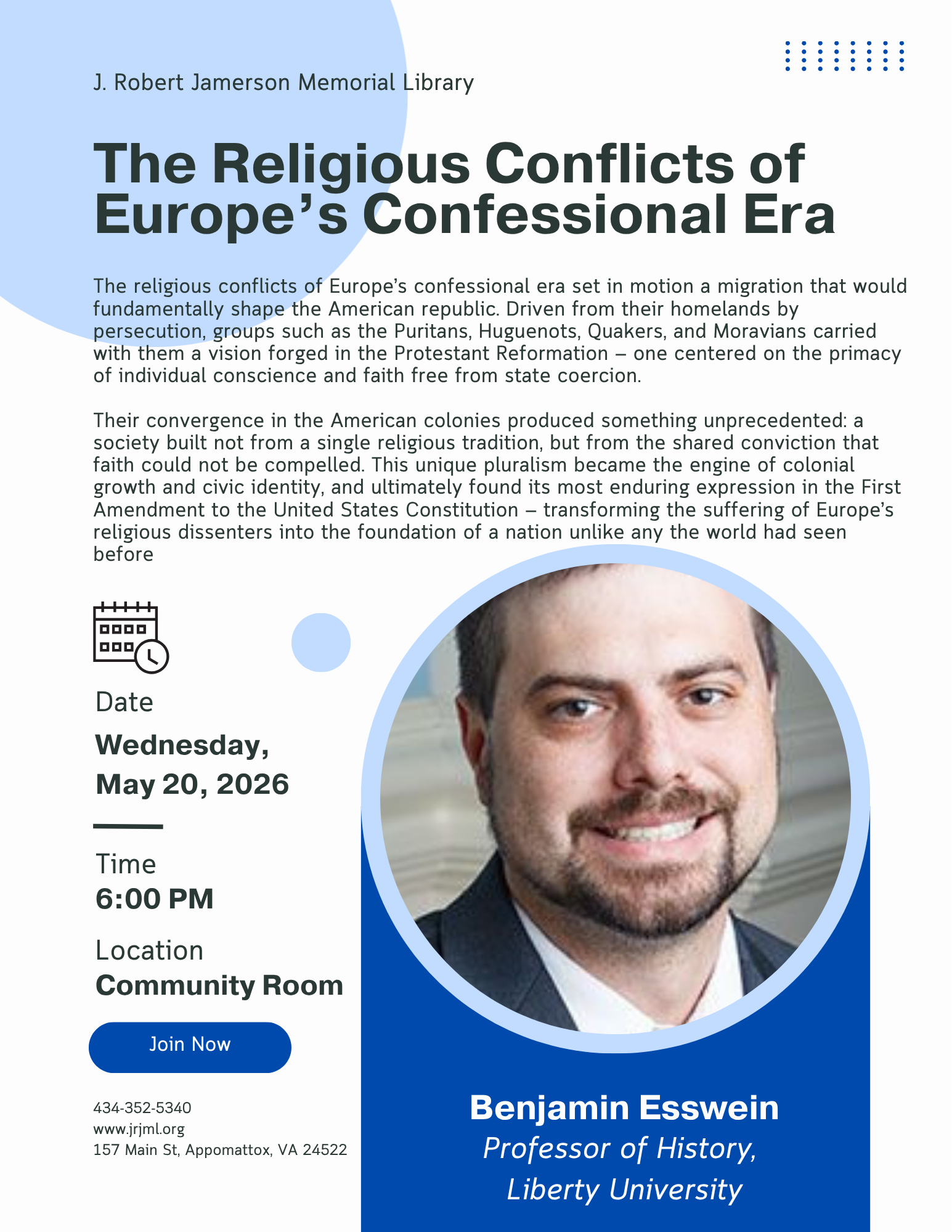
250th Anniversary of America presentation “The Religious Conflicts of Europe’s Confessional Era by Benjamin Esswein, starting at 6:00 pm in the Library’s Community Room. The religious conflicts of Europe’s confessional era set in motion a migration that would fundamentally shape the American republic. Driven from their homelands by persecution, groups such as the Puritans, Huguenots, Quakers, and Moravians carried with them a vision forged in the Protestant Reformation — one centered on the primacy of individual conscience and faith free from state coercion. Their convergence in the American colonies produced something unprecedented: a society built not from a single religious tradition, but from the shared conviction that faith could not be compelled. This unique pluralism became the engine of colonial growth and civic identity, and ultimately found its most enduring expression in the First Amendment to the United States Constitution — transforming the suffering of Europe’s religious dissenters into the foundation of a nation unlike any the world had seen before. Benjamin Esswein’s field of study is Early Modern Europe and the Reformation. He deals directly with Central and Eastern Europe, the Austro-Ottoman Borderlands in the sixteenth and early seventeenth century.